Manual Lever Espresso Machines: What to Know Before Buying (2026)
As an Amazon Associate I earn from qualifying purchases. Prices and availability are accurate as of the date/time indicated and are subject to change.
How we picked: This guide compares options using published
specifications, verified owner-review patterns and reputable expert testing.
We label clearly what is hands-on vs research-based, and never present others'
testing as our own.
Our top picks
| Rank | Product | Name | Why we picked it | Buy |
|---|---|---|---|---|
| Top pick | 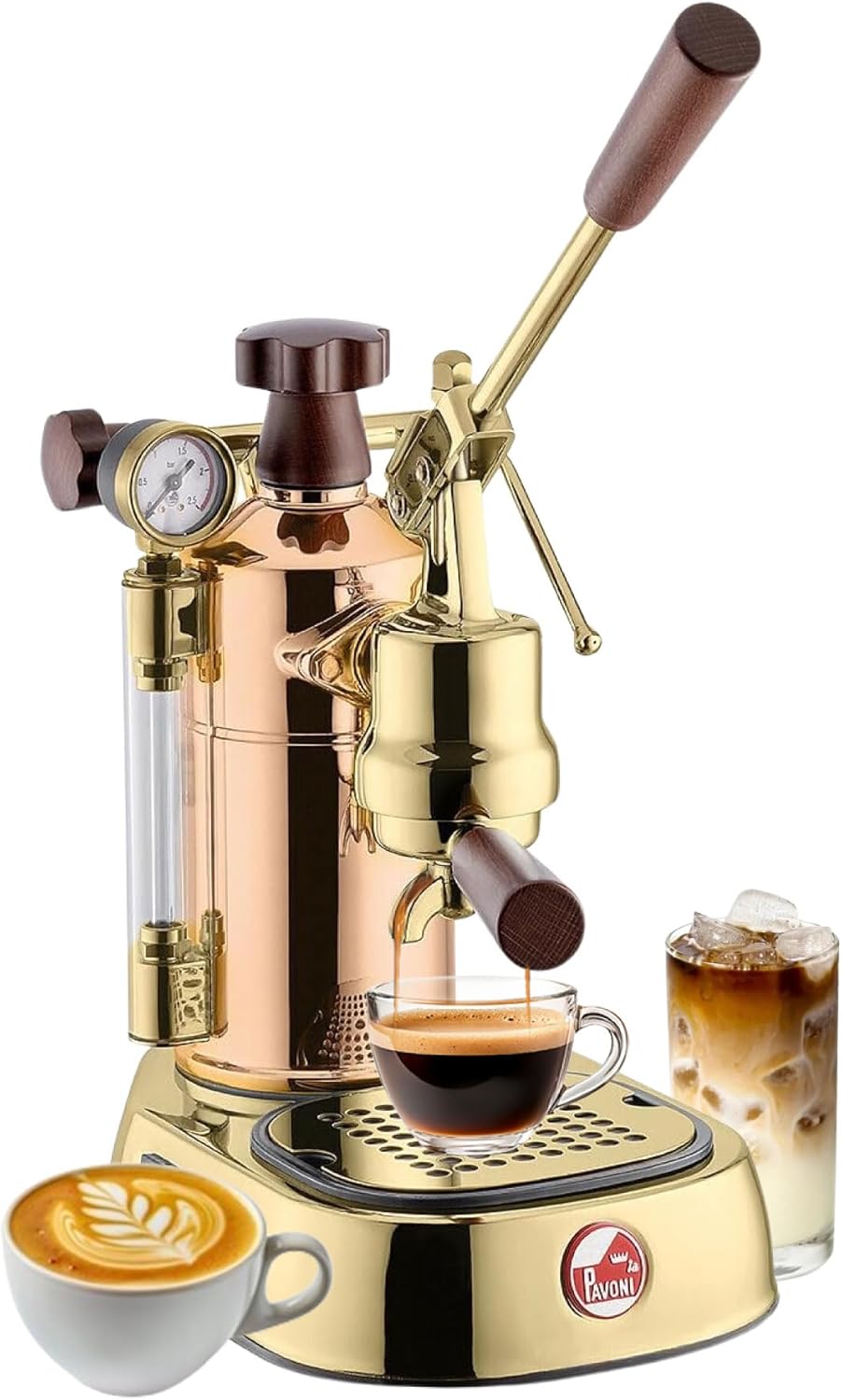 | La Pavoni Professional 16-Cup Lever Espresso Machine, Copper & Brass | Copper-and-brass Professional body, bottomless portafilter listed — top of the La Pavoni home-lever lineup, relevant if aesthetics/craftsmanship matter as much as function. | Check price |
| Runner-up |  | La Pavoni PSW-16 Stradivari Lever Espresso Machine, Chrome + Wood | Chrome finish with wood handles, solid brass boiler — similar 16-cup capacity, different aesthetic (chrome vs. copper), often at a different price point. | Check price |
| Also great |  | La Pavoni Bar 2L-B Lever Espresso Machine | Bar-series, larger 14L boiler, manometer for pressure control — designed for higher-throughput use, relevant if you regularly pull espresso for multiple people at once. | Check price |
📑 Table of contents
A manual lever espresso machine is a genuinely different beast from an automatic or semi-automatic. There’s no pump — you physically pull a lever to force water through the coffee, which means you control extraction pressure directly with your hand. It’s slower, less forgiving, and more rewarding for people who care about that specific tradeoff.
Why lever machines look expensive but “do less”
A modern automatic espresso machine has electronics, sensors, milk-frothing systems, pre-programmed drink options. A lever machine has a boiler, a lever, and a group head. The price on high-end lever machines like the La Pavoni Professional often exceeds mid-tier automatics — the cost isn’t features, it’s materials (brass, copper, wooden accents on the Professional/Stradivari picks) and manufacturing origin (all three La Pavoni picks list Made in Italy). If you want features, an automatic is a better spend; if you want craftsmanship and the mechanical experience, that’s what lever machines charge for.
What “pulling a shot” actually feels like on a lever
Fill the portafilter with tamped grounds. Lock it into the group head. Raise the lever slowly to charge water into the piston chamber (~5-8 seconds). Lower the lever with steady pressure to force the water through the coffee. Total pull time from lever-down to shot-end: 25-30 seconds when done well. Do it wrong and you get channeling, uneven extraction, or a shot that finishes in 10 seconds (under-extracted, sour) or 50 seconds (over-extracted, bitter). This is the learning curve people either love or hate — no button-press automation forgives your mistakes.
Does boiler size matter more than pressure control for home use?
For 1-2 shots at a time, no — a smaller 38oz brass boiler (La Pavoni Professional/Stradivari) heats faster and uses less power than a 14L Bar-series boiler. Where boiler size starts to matter is throughput: pulling shot after shot without waiting for reheat/pressure recovery, which the larger Bar 2L-B is specifically designed for. For a single home user, the smaller boilers are usually the right pick; for entertaining/multiple espresso drinks in sequence, the larger boiler avoids waiting between pulls.
Comparison
| Model | Body | Boiler | Best for |
|---|---|---|---|
| La Pavoni Professional | Copper + brass | 38oz | Top-tier home, bottomless portafilter |
| La Pavoni Stradivari PSW-16 | Chrome + wood | 38oz | Same tier, different aesthetic |
| La Pavoni Bar 2L-B | Chrome + brass groups | 14L | Higher throughput, pressure gauge |
Related guides
- Best espresso machine with built-in grinder
- Manual vs automatic espresso machines